Cybersecurity Has Entered the Age of Speed
Cybersecurity in 2026 is no longer simply about installing an antivirus, configuring a firewall, or checking server logs once a day.
The threat landscape has changed.
Attackers are using automation, artificial intelligence, stolen identities, cloud infrastructure and legitimate administrative tools to move faster than traditional security teams can respond. The World Economic Forum's Global Cybersecurity Outlook 2026 identifies AI as one of the biggest forces reshaping cybersecurity, with organizations facing increasingly sophisticated attacks while simultaneously struggling to keep security governance and expertise aligned with technological change.
At the same time, recent threat research shows that attackers are increasingly targeting identities, cloud environments, software supply chains and edge infrastructure rather than relying only on traditional malware.
This creates a fundamental problem:
Your organization may have many security tools—but still lack one clear view of what is actually happening.
That is where platforms like DEFENSOR.in become important.
The Problem With Traditional Security
Many organizations operate security through a collection of separate tools:
- Antivirus
- Firewall
- EDR
- Vulnerability scanner
- SIEM
- Network monitoring
- Log management
- Threat intelligence
- Malware detection
- Incident management
- SOAR
- Manual investigation tools
Each tool may work well independently.
But attackers do not operate in separate tools.
An attacker may:
Steal credentials → access a server → establish persistence → execute malware → communicate with an external server → move laterally → exfiltrate data.
If each event is visible only inside a different security product, security teams may see several individual alerts instead of one complete attack story.
Modern XDR approaches exist largely because organizations need to correlate security signals across endpoints, networks, cloud, identity and other layers rather than investigating every signal independently.
1. Attackers Are Moving Faster
One of the biggest changes in 2026 is speed.
Cyberattacks are becoming increasingly automated.
Fortinet's 2026 threat landscape research describes a shift toward machine-speed attacks, with attackers exploiting vulnerabilities in hours or days rather than the longer windows defenders historically had.
That means the traditional security model—
Detect → create ticket → wait for analyst → investigate → decide → respond
—can become dangerously slow.
Security needs to move toward:
Detect → Correlate → Investigate → Decide → Respond
with as much automation as safely possible.
This is one of the fundamental ideas behind modern security platforms such as DEFENSOR.
2. AI Is Changing Both Sides of Cybersecurity
AI is not only a defensive technology anymore.
Attackers can use AI to accelerate:
- Reconnaissance
- Social engineering
- Credential attacks
- Vulnerability discovery
- Malware development
- Phishing
- Operational planning
- Data theft
At the same time, defenders can use AI and automation for:
- Threat detection
- Alert correlation
- Security analysis
- Threat scoring
- Investigation
- Incident enrichment
- Response orchestration
The 2026 Global Cybersecurity Outlook reports that 94% of respondents see AI as the most significant driver of cybersecurity change, while AI-related vulnerabilities are also being identified as one of the fastest-growing areas of cyber risk.
So the question is no longer:
"Should we use AI in cybersecurity?"
The better question is:
"How quickly can our security operations use automation and intelligence to respond to AI-accelerated attacks?"
3. Identity Has Become a Major Attack Surface
Modern attackers don't always need to "break into" a system.
Sometimes they simply log in.
Stolen passwords, access tokens, cloud credentials, API keys and compromised accounts can provide attackers with legitimate-looking access.
Palo Alto Networks' 2026 Unit 42 research highlights identity weaknesses as a major factor in successful intrusions, while Google Cloud reports that identity issues played a major role in cloud incidents and that attackers increasingly use legitimate access channels to move toward sensitive data.
This changes the security requirement.
Organizations need visibility into:
Who accessed what?
From where?
When?
What happened after authentication?
Did the user's behavior suddenly change?
Was the account used to establish persistence or access sensitive systems?
Security must therefore connect identity, endpoint, network and system behavior.
4. Linux Servers Need Continuous Security Visibility
Linux remains a critical part of modern infrastructure.
Web servers, databases, cloud workloads, containers, application servers and internal infrastructure frequently depend on Linux.
But Linux security cannot be limited to malware scanning.
A modern Linux security strategy should consider:
- Processes
- Network connections
- Open ports
- Services
- System configuration
- Vulnerabilities
- Malware
- YARA detections
- SSH activity
- Persistence mechanisms
- Cron jobs
- Systemd services
- Shell startup files
- Suspicious files
- User activity
- Application behavior
A compromised Linux server may not immediately display obvious malware.
An attacker could establish persistence through a scheduled task, service, SSH key, startup configuration or another legitimate mechanism.
Therefore:
Continuous visibility matters more than occasional scanning.
5. Detection Alone Is Not Enough
Imagine your security system detects a suspicious process.
That's good.
But what happens next?
Does the system:
- Create an incident?
- Identify the affected host?
- Determine the user involved?
- Correlate network activity?
- Check threat intelligence?
- Identify persistence?
- Determine severity?
- Collect evidence?
- Recommend a response?
- Execute an approved response?
If the answer is "the analyst has to do everything manually," the organization still has a significant response gap.
This is where SOAR and security automation become valuable.
SOAR is designed to orchestrate response actions across security tools and workflows, reducing repetitive manual work and allowing analysts to concentrate on decisions that actually require human judgment.
6. Why Organizations Need a Unified Security Platform
The goal is not simply to buy another cybersecurity product.
The goal is to create a security operating layer.
A modern platform should bring together:
Endpoint Security
Monitor servers and endpoints for suspicious processes, malware and behavioral anomalies.
Network Security
Understand connections, traffic patterns, suspicious destinations and unusual network behavior.
Vulnerability Management
Identify weaknesses before attackers exploit them.
Threat Detection
Correlate security events and identify meaningful attack patterns.
Threat Intelligence
Add context to suspicious IPs, domains, hashes and indicators.
Digital Forensics
Help security teams understand what happened before, during and after an incident.
Incident Management
Turn individual detections into structured investigations.
Security Automation
Execute predefined response actions quickly and consistently.
Security Operations
Give analysts one place to understand security posture, incidents, threats and response.
That is the direction modern cybersecurity is moving toward.
7. Where DEFENSOR.in Fits
DEFENSOR.in is designed around this unified security philosophy.
Instead of treating cybersecurity as a collection of disconnected products, the objective is to bring critical security capabilities together into one enterprise cyber defense platform.
The platform's security vision combines:
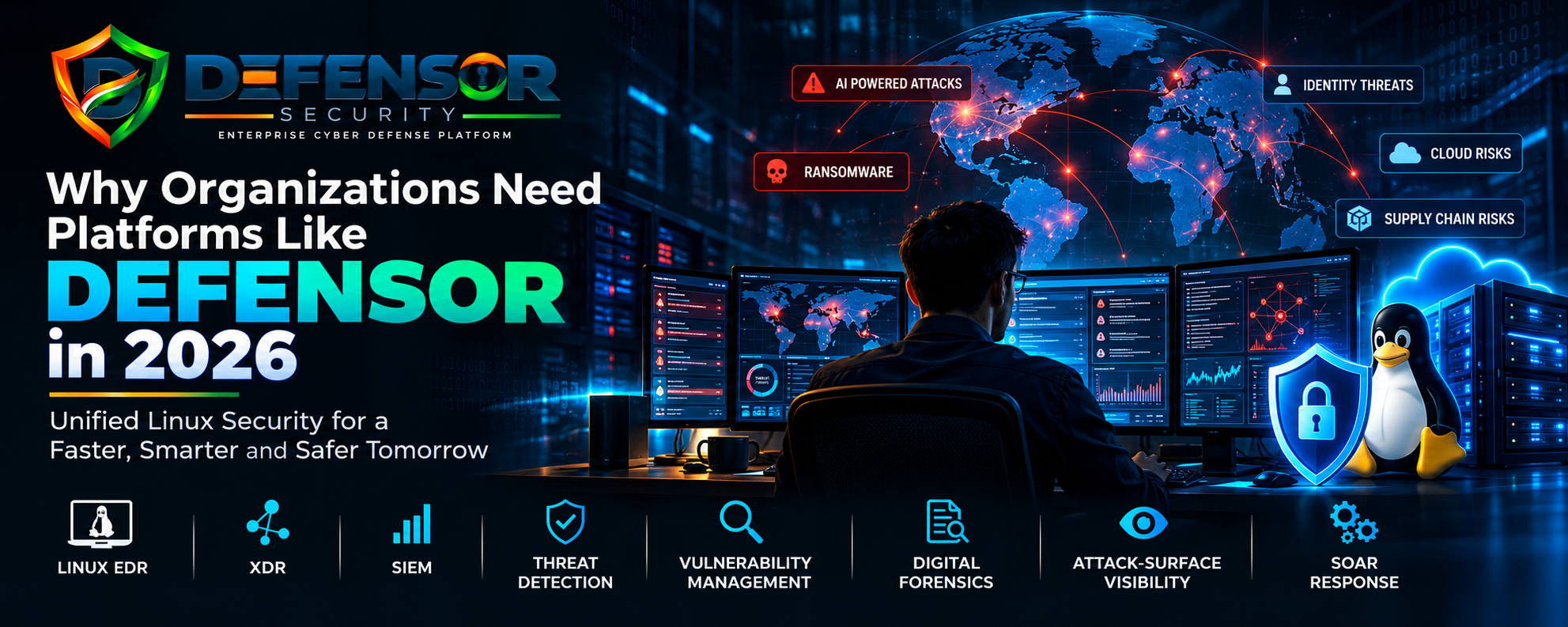
Linux EDR + XDR + SIEM + Threat Detection + Vulnerability Management + Digital Forensics + Attack-Surface Visibility + SOAR
into a connected security ecosystem.
The real value is not simply having all these words on a product page.
The value comes from connecting them.
For example:
Endpoint Detection
↓
Network Activity
↓
Threat Intelligence
↓
Persistence Detection
↓
Incident Correlation
↓
Risk Evaluation
↓
Response Policy
↓
SOAR Action
This creates something much more useful than a collection of isolated alerts:
An actionable security story.
8. Detection Should Lead to Action
Consider a simple example.
A Linux server suddenly creates a suspicious persistence mechanism.
A traditional monitoring system might simply report:
"New cron entry detected."
A modern security platform should ask:
- Which server?
- Which user?
- When was it created?
- What command does it execute?
- Is the command suspicious?
- Did a suspicious process appear afterward?
- Did the server communicate with an unusual external IP?
- Is that IP associated with known threats?
- Was there an unusual login before the change?
- Does this activity match an existing detection rule?
- Should an incident be created?
- What response policy applies?
- Does the action require approval?
- Can an approved SOAR playbook contain the threat?
That is the difference between monitoring and security operations.
9. Why This Matters for Small and Mid-Sized Organizations
Enterprise cybersecurity is often associated with large companies with huge SOC teams.
But smaller organizations can be even more exposed because they may have:
- Limited security staff
- No 24/7 SOC
- Multiple servers
- Cloud infrastructure
- Remote access
- Public-facing applications
- Limited incident response capability
- Multiple disconnected security products
Recent 2026 research also highlights the growing pressure on smaller organizations as AI makes attacks easier to scale while many organizations remain underprepared.
This creates a dangerous gap.
An organization may not need hundreds of security products.
It needs visibility, intelligence and response.
10. The Future Is Not More Alerts
One of the biggest mistakes in cybersecurity is believing that more alerts automatically mean better security.
They don't.
A security team receiving 10,000 alerts but unable to determine which five matter most is not necessarily more secure than a team receiving 500 well-correlated incidents.
The future is about:
Less noise.
More context.
Faster investigation.
Better prioritization.
Controlled automation.
Measurable response.
This is why modern XDR, SIEM and SOAR capabilities increasingly work together rather than being treated as completely separate worlds.
11. Cybersecurity in 2026 Is About Resilience
Security is no longer only about preventing every attack.
That is impossible.
A mature security strategy asks:
Can we detect an attack early?
Can we understand what happened?
Can we identify affected systems?
Can we contain the threat?
Can we recover?
Can we preserve evidence?
Can we learn from the incident?
Can we improve our defenses afterward?
That is cyber resilience.
And this is where a platform such as DEFENSOR can become more than a monitoring dashboard.
It can become part of the organization's operational security infrastructure.
DEFENSOR.in: From Visibility to Defense
The cybersecurity industry is moving toward platforms that connect detection, investigation and response.
In 2026, attackers are faster.
AI is accelerating both offense and defense.
Identity has become a major attack surface.
Cloud environments are increasingly interconnected.
Supply-chain dependencies create new attack paths.
And traditional manual security operations are struggling to keep pace.
Organizations therefore need security systems designed around continuous visibility and rapid response.
That's the philosophy behind DEFENSOR.in.
Not just another security dashboard.
Not just another scanner.
Not just another alerting system.
But a unified approach to:
Detect. Investigate. Understand. Respond. Defend.
Because in 2026, cybersecurity isn't about asking whether an organization will be targeted.
The more important question is:
When the attack starts, how quickly can you see it—and how effectively can you stop it?