
Linux servers are at the heart of modern infrastructure. They power applications, APIs, databases, cloud workloads, business platforms and critical services.
But securing a Linux environment is no longer just about protecting files or running an antivirus scan.
Modern attacks can reveal themselves through network behavior long before they become a confirmed security incident.
That is why network visibility has become an important part of enterprise cyber defense.
Introducing Defensor Network Monitoring
DEFENSOR.in brings network visibility together with Linux security, threat detection, digital forensics, attack-surface visibility and SOAR response.
The goal is simple:
Detect. Investigate. Respond.
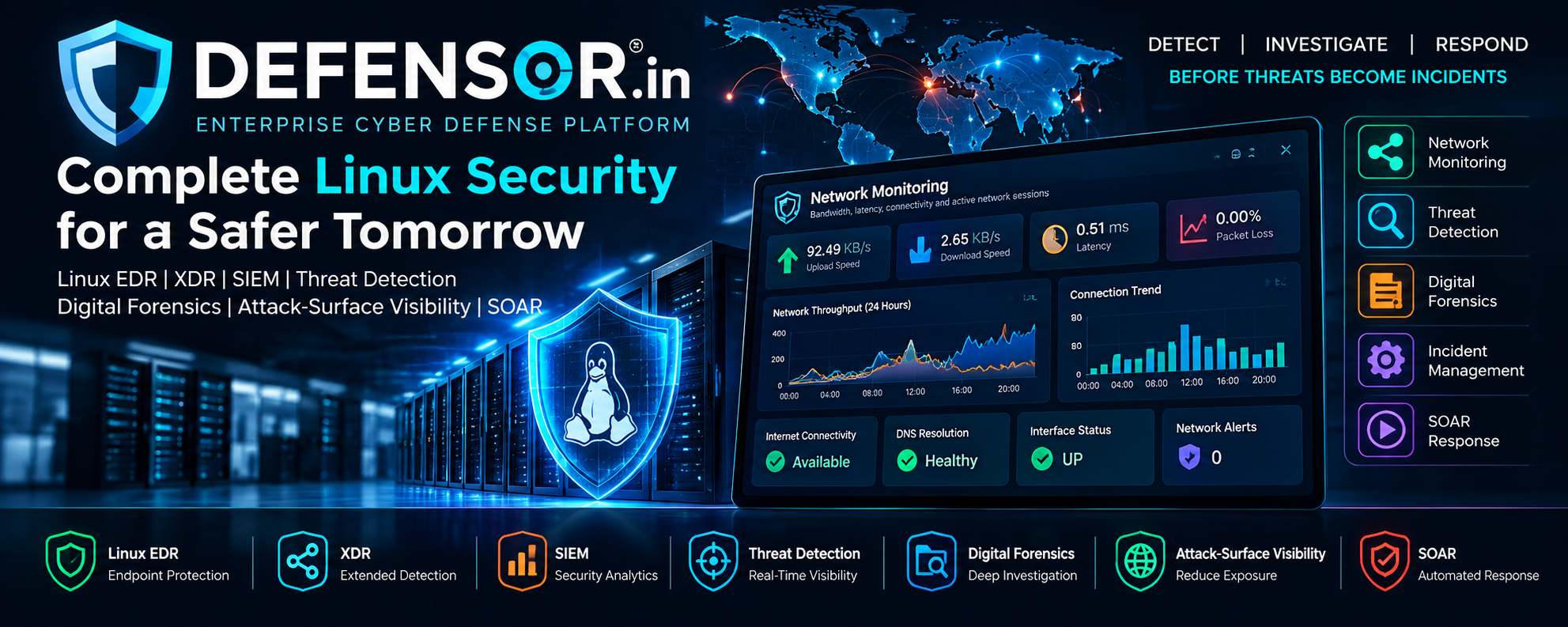
Defensor Network Monitoring provides visibility into the network activity reported by the security agent, including interface health, bandwidth, latency, packet loss, DNS status, active connections and listening services.
This gives security teams a clearer picture of what is happening on their Linux infrastructure.
See Your Network in Real Time
A healthy network connection is an important foundation for a secure server.
Defensor monitors key connectivity indicators such as:
- Upload and download activity
- Network latency
- Packet loss
- Internet connectivity
- DNS resolution
- Network interface status
- Established connections
- Listening sockets
- Network alerts
Instead of looking at a single number in isolation, security teams can compare current activity with the server's normal workload and historical behavior.
Not Every Public IP Is a Threat
One of the most important principles of effective network security is avoiding false assumptions.
A public IP address is not automatically malicious.
An unusual port is not automatically an attack.
A listening service is not automatically vulnerable.
An unfamiliar process is not automatically malware.
Defensor therefore uses an explainable, context-aware and read-only detection approach.
Network signals can include unusual remote ports, rare destinations, unusual processes, script or shell-capable public egress and repeated connection activity.
These signals are treated as evidence—not automatic verdicts.
From Network Signals to Security Findings
The real value of network monitoring comes from correlation.
A single observation may not mean much. Multiple independent observations, however, can provide stronger evidence.
Defensor follows an evidence-oriented chain:
Agent Network Telemetry
↓
Normalization & Connection Context
↓
Detection Rule Evaluation
↓
Suspicious Connection Signal
↓
Security Brain Correlation
↓
Incident Management
↓
Response Policy
↓
SOAR
This allows network observations to become part of the existing security workflow without creating a separate response pipeline.
DNS Security Visibility
DNS is another important part of network security.
Defensor currently provides visibility into resolver health and DNS resolution availability based on the telemetry supplied by the agent.
Importantly, the platform does not invent domain-level threats when query-level telemetry is unavailable.
Future DNS security capabilities can use telemetry such as:
- Domain
- Query type
- Resolver
- Response code
- Answer count
- Query frequency
- Query length
- Entropy
- Process context
This provides a foundation for more advanced DNS anomaly and tunneling detection when the required agent telemetry becomes available.
Understand Your Attack Surface
Listening services represent an important part of a server's observed network surface.
Defensor can identify listening sockets and provide service-level context when the agent supplies connection information.
However, a listening socket alone does not prove that a service is exposed to the internet.
Actual exposure depends on factors such as:
- Firewall policy
- Cloud security groups
- Routing
- Network architecture
- Bind address
- Service configuration
This distinction is important because effective security depends on evidence from multiple layers, not assumptions from a single metric.
Explainable Network Detection
Defensor introduces network detection signals designed to help security teams investigate unusual behavior.
Examples include:
NET-PORT-ANOMALY
Unusual remote service port activity.
NET-DEST-RARITY
A destination that is unusual for the endpoint.
NET-REMOTE-PORT-RARITY
Low-frequency remote port behavior.
NET-PROCESS-ANOMALY
Unknown or unusual process activity when process telemetry is available.
NET-SCRIPT-EGRESS
Script or shell-capable process making a public outbound connection.
NET-CONNECTION-BURST
Repeated or burst connection behavior.
These detections are designed to provide contextual signals, not instant accusations.
Security That Connects the Evidence
Modern security platforms need to do more than generate alerts.
They need to help analysts understand the evidence behind those alerts.
Defensor connects:
Source → Destination → Process → Behavior → Correlation → Threat Candidate → Existing Incident → Response
This creates a clearer investigation path while maintaining the existing Incident Management, Response Policy and SOAR architecture.
One Platform for Modern Linux Defense
Defensor brings multiple security capabilities together:
Linux EDR
Endpoint visibility and protection.
XDR
Extended detection across security telemetry.
SIEM
Security analytics and centralized visibility.
Threat Detection
Identify suspicious behavior and security signals.
Digital Forensics
Investigate evidence when deeper analysis is required.
Attack-Surface Visibility
Understand exposed services and network surfaces.
SOAR
Connect confirmed security findings to automated response workflows.
Together, these capabilities create a more complete approach to Linux security.
Security Starts With Visibility
You cannot investigate what you cannot see.
And you cannot confidently respond to what you cannot understand.
That is why network monitoring is more than a dashboard of bandwidth numbers.
It is a foundation for understanding:
What is communicating?
Where is it communicating?
Which process is responsible?
Is the behavior unusual?
Does the evidence indicate a real security finding?
What should happen next?
With an evidence-driven approach, Defensor helps security teams move from raw telemetry toward meaningful security decisions.
DEFENSOR.in
Complete Linux Security for a Safer Tomorrow.
Defensor brings Linux EDR, XDR, SIEM, Threat Detection, Digital Forensics, Attack-Surface Visibility and SOAR Response into one enterprise cyber defense platform.
DETECT | INVESTIGATE | RESPOND
The objective is not simply to generate more alerts.
The objective is to provide better visibility, better evidence and better security decisions—before threats become incidents.
DEFENSOR.in — Enterprise Cyber Defense Platform